Plastic Food Packaging is not one material, but a family of formats built to protect food, extend shelf life, and fit production lines. A clear water bottle may use PET; a milk jug, HDPE; and a microwaveable tub, polypropylene. Thin films, pouches, foam trays, and layered wrappers add further options. Each behaves differently under heat, moisture, pressure, and transport. The choice matters at the shop and at the sorting facility.
The market is large. Grand View Research estimated the global plastic packaging market at USD 431.3 billion in 2023, with growth expected through 2030. That figure covers more than food packaging, so it is useful context, not a food-only measure. Circular-economy pioneer Ellen MacArthur describes the broader design challenge: “A circular economy is based on the principles of designing out waste and pollution, keeping products and materials in use, and regenerating natural systems.” These principles help explain why material choice, package design, and local collection systems belong in the same conversation. A package that looks simple may contain several bonded layers. That can improve barrier performance, yet complicate recovery. Labels such as “recyclable” also depend on access to suitable collection and processing. Details matter.
This guide compares common plastic food packaging types, their uses, strengths, and limitations. It also asks a less tidy question: what happens after the last bite? No single material solves every need. That is worth remembering.
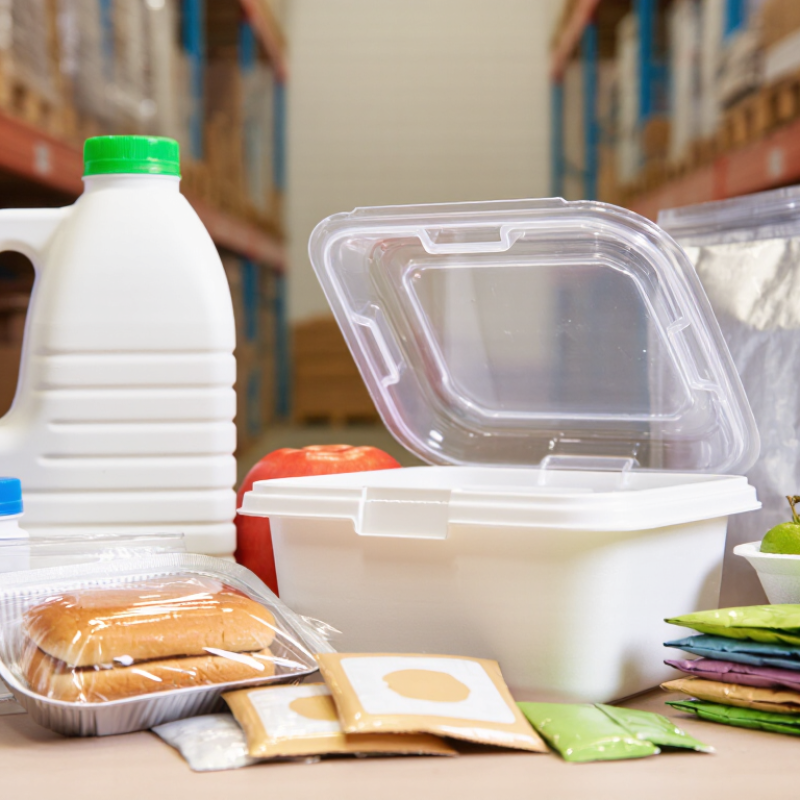
How Plastic Food Packaging Is Classified
What Are the Types of Plastic Food Packaging?
How Plastic Food Packaging Is Classified
Plastic food packaging can be classified by material, shape, and the job it performs. Material matters because different plastics handle heat, moisture, and impact differently. Polyethylene is common in flexible films and bags, while rigid containers may use polypropylene or polyethylene terephthalate. These are broad examples, not a reliable way to identify an item by sight alone.
Shape offers another practical classification. Films, pouches, trays, tubs, bottles, and caps each protect food in different ways. A clear tray may keep berries visible, while a sealed pouch can limit spills and exposure to air. Some packs combine several layers. That can improve protection, but it also makes sorting and recycling more difficult. Details matter.
Packaging is also grouped by function: primary packaging touches the food, secondary packaging bundles individual packs, and transport packaging supports shipping. Barrier performance is another useful lens. Some materials slow moisture, oxygen, or light; others mainly contain and protect the product. In practice, these categories overlap. A container may be rigid, food-contact, and moisture-resistant at once. Classification helps explain a pack, but it does not tell the whole story. Labels, local collection rules, and actual material composition still need checking. One limitation: packaging descriptions can sound more precise than the item itself.
What Are the Types of Plastic Food Packaging? - How Plastic Food Packaging Is Classified
| Classification | Common Forms | Typical Food-Packaging Uses | Key Characteristics | Important Considerations |
|---|---|---|---|---|
| PET (Polyethylene terephthalate) Resin code 1 |
Rigid bottles, jars, trays, and films | Beverage bottles, cooking-oil bottles, and clear food trays | Lightweight, clear, and a good moisture barrier | Recycling acceptance varies by location and package format. Follow the package label for heating or reuse instructions. |
| HDPE (High-density polyethylene) Resin code 2 |
Rigid bottles, tubs, and containers | Milk and juice jugs, food tubs, and some condiment bottles | Tough, lightweight, and resistant to moisture | Local recycling programs determine which shapes and colors they accept. |
| PVC (Polyvinyl chloride) Resin code 3 |
Flexible films and some rigid packaging | Certain food overwraps and specialized packaging applications | Can be made flexible or rigid, depending on its formulation | Food-contact use depends on the specific formulation and applicable regulations. Do not heat packaging unless its label says it is suitable. |
| LDPE (Low-density polyethylene) Resin code 4 |
Bags, pouches, wraps, and squeeze bottles | Bread bags, frozen-food bags, produce bags, and some flexible lids | Flexible, lightweight, and moisture-resistant | Flexible films are not accepted in every curbside recycling program; check local guidance. |
| PP (Polypropylene) Resin code 5 |
Tubs, cups, lids, caps, and films | Yogurt and margarine tubs, takeaway containers, and snack packaging | Lightweight and often suited to a wider range of temperatures than some common packaging plastics | Microwave suitability depends on the specific package. Use only when the label indicates it is microwave-safe. |
| PS (Polystyrene) Resin code 6 |
Rigid cups and trays; expanded foam containers | Some disposable cups, food trays, and protective food-service containers | Can be rigid or expanded into a lightweight insulating foam | Collection and recycling options are limited in many areas and vary locally. |
| Other plastics and multilayer materials Resin code 7 or no single code |
Specialty rigid plastics, barrier films, and laminated structures | Some reusable water containers, high-barrier pouches, and packages combining plastic layers with other materials | Properties vary widely; multiple layers can help protect food from oxygen, moisture, or light | Code 7 covers a broad group and does not identify one specific plastic. Multilayer packaging can be difficult to separate and recycle. |
How to read the classifications: Resin identification codes describe the type of plastic resin, not whether a package is recyclable in a particular area. Packaging suitability for food contact, storage, or heating depends on the specific product and its label.
FAQS
It can be grouped by material, shape, and function. A berry tray, film wrap, and shipping box serve different roles. These categories can overlap.
Primary packaging touches the food. Secondary packaging bundles individual packs. Transport packaging helps protect goods during shipping. A box may do more than one job.
PET often holds drinks and oils. HDPE is used for sturdy containers, while LDPE is common in flexible bags. PP appears in some food tubs.
No. It identifies a plastic family, not every safe use. Check the package instructions, especially before heating food.
Films, wraps, bags, sachets, and pouches are common. A flat sachet may hold one serving; a stand-up pouch can hold sauce or snacks.
Layer structure, film thickness, and seal quality all matter. A weak edge may split under pressure. Zippers do not replace the initial seal.
Some materials slow moisture, oxygen, or light. Crisp snacks need protection from humidity, while oily foods may need grease-resistant packaging. Details matter.
No. Multiple bonded layers can make sorting harder, and collection rules vary locally. Check the material and local guidance; appearance alone can mislead. I may be oversimplifying.
Conclusion
Plastic Food Packaging is commonly classified by the material it is made from and the form it takes. Different plastic resins offer different qualities, such as flexibility, clarity, strength, or resistance to moisture. These properties help determine whether a material is suitable for wrapping, containing, or protecting a particular food. Plastic packaging is generally divided into flexible types, such as films, pouches, and bags, and rigid types, such as tubs, trays, bottles, and containers.
The best packaging type depends on the food’s shape, texture, and storage needs. Flexible packaging can fit around products or provide lightweight, convenient portions, while rigid packaging helps maintain a defined shape and protect foods that need a sturdy container. By considering the food and the properties of the packaging material together, manufacturers can choose a format that supports handling, storage, and presentation.
