Global buyers face a practical challenge: disposable food packaging must protect meals, survive transport, and fit local operations. A paper bowl may handle a dry pastry well, yet soften under hot soup. A clear container can show freshness, but its performance depends on the food, seal, and delivery time. Small specification choices matter.
The scale is significant. The OECD’s Global Plastics Outlook (2022) estimates that packaging represented 40% of global plastic waste in 2019. That figure does not mean every package has the same impact. Material weight, food contamination, collection access, and local processing all affect what happens after use. As architect and circular-design expert William McDonough puts it, “Waste is food.” It is a useful design principle, not a guarantee that packaging will be recycled or composted.
This guide presents 10 Disposable Food Packaging tips to help buyers compare options with clearer criteria. It looks at food compatibility, barrier performance, leak resistance, shipping durability, labeling, supplier evidence, and total cost—not just the unit price. Ask for product specifications and test samples with the actual menu. Check how containers behave after stacking, reheating, or a bumpy delivery route. Then verify environmental claims against the package’s materials and the disposal systems available to customers.
There is no perfect choice. A lighter pack may reduce material use but protect food less effectively. That trade-off deserves scrutiny. These tips offer a starting point, not a substitute for product testing or careful supplier review.
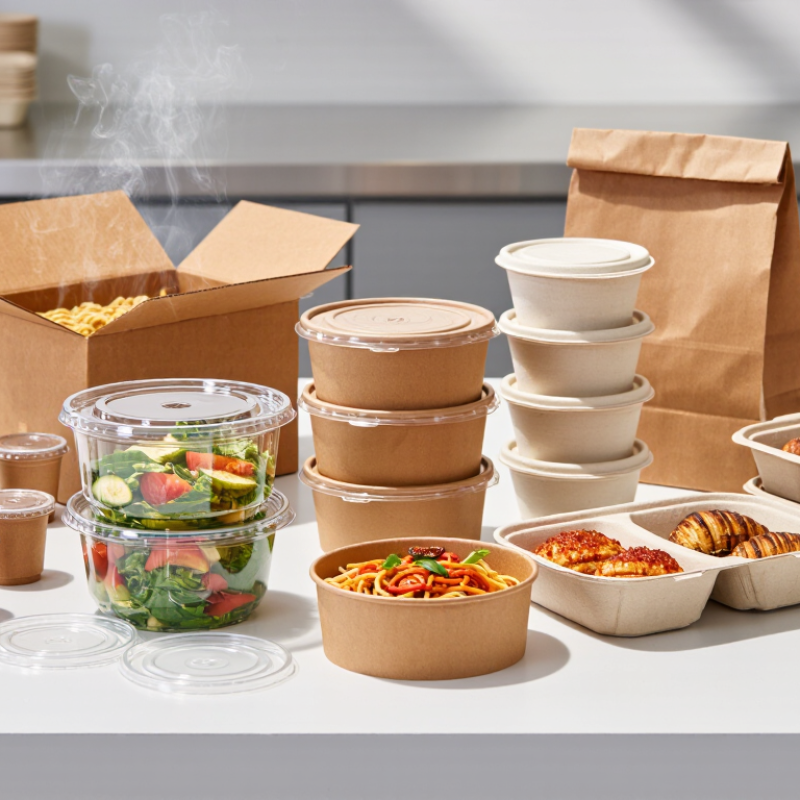
Define Food, Product, and Destination-Market Requirements
Before requesting quotes, define the food itself. A hot, oily curry needs different leak and heat resistance from chilled berries or dry biscuits. Record serving temperature, moisture, fat content, portion size, expected holding time, and whether food will be reheated. Small details matter. A lid that fits a sample may loosen during delivery, so test filled packs under realistic handling conditions.
Destination markets can change the specification. Check local rules for food-contact materials, required labels, recycling claims, and language before approving artwork. Also ask whether collection systems actually accept the chosen material; a technically recyclable pack may have few local recovery options. FAO’s 2019 report, The State of Food and Agriculture, estimated that 14% of food is lost between post-harvest and retail worldwide. Packaging alone cannot prevent that loss, but unsuitable protection can add risk. UNEP’s Food Waste Index Report 2024 estimated 1.05 billion tonnes of food waste in 2022 across households, food service, and retail. Treat those figures as context, not proof that one package solves food waste. Build a destination-specific checklist, then verify it with a local importer or qualified compliance adviser. Some assumptions will be wrong. Recheck them.
10 Disposable Food Packaging Tips for Global Buyers - Define Food, Product, and Destination-Market Requirements
| No. | Requirement Area | What to Define | Buyer Checkpoint | Why It Matters |
|---|---|---|---|---|
| 1 | Food type and composition | Identify whether the food is aqueous, acidic, alcoholic, fatty, or dry, and list relevant ingredients such as oils, sauces, or salt. | Share a representative food sample or a complete product specification with the packaging supplier. | Food composition can affect material compatibility and the applicable food-contact testing conditions. |
| 2 | Temperature conditions | Specify filling temperature and the full use range, including hot filling, refrigeration, freezing, reheating, or microwave use. | Confirm that the exact packaging construction is suitable for each stated temperature and use condition. | Heat and cold can affect packaging performance and may change which compliance tests are appropriate. |
| 3 | Product and package format | Define the food portion, container capacity, dimensions, closure type, and whether the pack is a cup, tray, bag, wrap, or box. | Check dimensions and fit using production samples; assess closures for leakage or accidental opening where relevant. | A suitable format helps protect the food, support filling operations, and reduce damage in handling. |
| 4 | Shelf life and barrier needs | Set the required shelf life and determine whether protection from moisture, oxygen, light, or grease is needed. | Validate the complete package with the actual food and storage conditions rather than relying only on a material description. | Barrier performance is product- and use-dependent; it can influence quality, freshness, and food waste. |
| 5 | Transport and distribution | Map the route from packing to final sale, including stacking, vibration, humidity, long transit, and temperature changes. | Test filled packs and shipping cases under realistic distribution conditions. | Packaging that performs at the filling line may still need protection against transit damage or compression. |
| 6 | Destination-market rules | Identify every country or region where the packaging will be placed on the market and the applicable food-contact requirements. | For example, check relevant EU rules such as Regulations (EC) No 1935/2004 and (EU) No 10/2011 for plastics, US FDA food-contact requirements, or the applicable national rules in other markets. Confirm current requirements with a qualified compliance professional. | Food-contact requirements vary by market and material; approval or documentation for one market may not cover another. |
| 7 | Material and food-contact evidence | Record the material layers, coatings, inks, adhesives, recycled content, and intended food-contact surface. | Request relevant declarations, test reports, and traceability records for the specific packaging specification and intended use. | Compliance depends on the complete construction and conditions of use, not just the base material name. |
| 8 | Labeling and language | Determine required languages, food information, date coding, storage instructions, and any packaging or recycling marks. | Have destination-market label artwork reviewed before printing; keep mandatory food labeling distinct from optional claims. | Labeling rules differ across markets, and incorrect or incomplete artwork can delay market entry. |
| 9 | Environmental claims and disposal | Define the intended disposal route and the evidence needed for claims such as recyclable, compostable, or recycled content. | Check local collection and processing infrastructure, relevant standards, and claim rules in each destination market. | Environmental performance and accepted disposal routes vary by location; avoid claims that cannot be substantiated locally. |
| 10 | Specifications and change control | Document dimensions, tolerances, material structure, color, print, sealing requirements, and approved use conditions. | Agree on sample approval, inspection criteria, batch traceability, and advance notification of changes to materials or production. | Clear specifications help keep repeat orders consistent and make it easier to assess the impact of a product change. |
Buyer note: Confirm legal requirements, test conditions, and labeling obligations for the specific food, packaging construction, and destination market before placing a production order.
FAQS
Record serving temperature, moisture, fat content, portion size, holding time, and reheating needs. Curry and berries need different protection.
Fill samples with the actual food, close them, and test realistic handling. A lid may loosen during delivery.
Requirements can vary for food-contact materials, labels, languages, recycling marks, and environmental claims. Verify them for each market.
No. Check the listed material, coating, food type, and temperature limits. A cold-food test may not cover hot, oily meals.
Request the full report and confirm the laboratory is appropriately accredited. Compare the report’s product details with your sample.
Not without checking local requirements. Review a print-ready proof at actual size; small text can blur on a folded carton.
Check whether local collection systems accept that material. A technically recyclable package may have few nearby recovery options.
Save dated reports, specifications, and approved artwork. Review them when materials or suppliers change. I would still double-check the finished package.
Conclusion
Choosing Disposable Food Packaging for international markets requires more than selecting a container. Buyers should first define the food’s needs, including temperature, moisture, shelf life, portion size, and delivery method, then match those requirements with suitable materials and formats. Compare packaging options for strength, leak resistance, ease of use, and suitability for storage and transport. Confirm that products meet applicable food-contact safety standards and that required certifications and labeling information are available for each destination market.
Before placing an order, evaluate suppliers by reviewing samples, production capacity, quality controls, lead times, and transparent pricing. Consider shipping conditions, storage requirements, and how packaging will be handled after use. Sustainability goals should be balanced with practical performance, local disposal options, and clear guidance for recycling or composting where available. A careful evaluation of these factors can help buyers reduce avoidable costs, protect food quality, and choose packaging that fits both operational needs and customer expectations.